
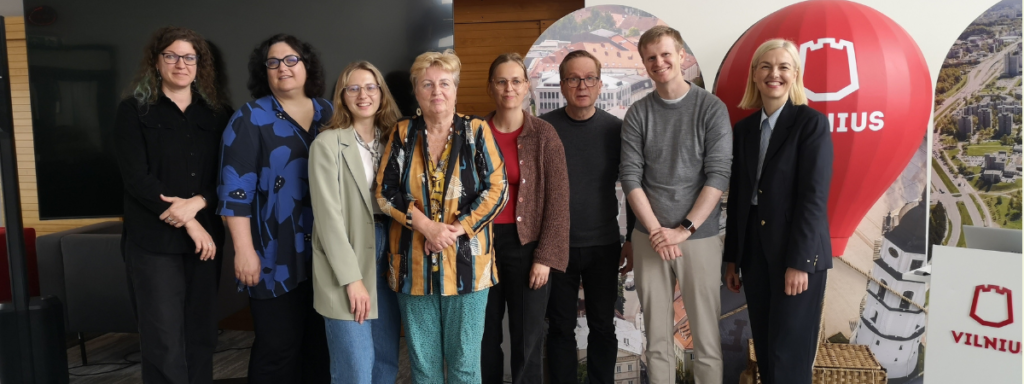
Peer Support Gains Momentum in Lithuania
What are the obstacles and key requirements when implementing peer support in a new field? These were the main questions discussed at a mini conference in Vilnius, Lithuania, on May 19th, where healthcare professionals from Lithuania and partners in the Nordplus project Nordic and Baltic Corporation for Peer Support Workers gathered to discuss peer support – its implementation, education, and organization. By the end of the conference, one thing was clear: peer support has a promising future in Lithuania.
By Marie Vester Koch, the Peer-Partnership Association
On May 19th, the Vice Mayor of Vilnius, together with the Lithuanian organization Mental Health Perspectives, invited healthcare professionals from the psychiatric field in Lithuania, as well as representatives from the Ministry of Health, to attend a half-day conference in Vilnius.
During the conference, representatives from Norway, Sweden, Iceland, and Denmark participating in the Nordplus project Nordic and Baltic Corporation for Peer Support Workers presented how peer support is organized and implemented in their respective countries, as well as how peer support workers are trained.
The presentations highlighted the different ways peer support is organized across countries and offered inspiration for various models of implementation and education.
In Norway, the focus has been on creating a sustainable model for educating peer support workers, which is now on its way to being recognized as a university-level course.
In Sweden, an organizational model has been developed in which peer support workers are trained and supervised by civil society organizations while being integrated into the public healthcare system. This model has proven especially valuable in preventing “peer drifting.”
Iceland presented a strong example of how peer support can be implemented from the ground up through grassroots movements and a few dedicated advocates with lived experience of mental illness.
Denmark provided examples of how different organizational models are used across both public services and civil society organizations. Peer support workers have been part of the public psychiatric system in Denmark for the past 10 years, bringing valuable lessons and highlighting areas that still need improvement – for example, the need for more education and clearer career paths for peer support workers.
At the end of the mini conference, participants engaged in group discussions around the question: “What needs to be in place within an organization to successfully implement peer support?”
Some of the key points raised during the discussions were the importance of reducing stigma within the existing workforce, as well as the need for clear role descriptions outlining the expectations and responsibilities of peer support workers. This would help reduce both the risk of peer drifting and the risk of exclusion.
One of the most pressing issues discussed was the need for funding in a field that is already facing financial challenges. However, representatives from the Ministry of Health shared encouraging news about plans to fund peer support workers within the Lithuanian psychiatric system within the next two years.
Overall, the conference left participants optimistic that peer support will soon become available to service users and people struggling with mental health challenges in Lithuania.
Background for meeting in Lithuania
The conference in Lithuania was organized as a part of the project Nordic and Baltic Corporation for Peer Support Workers.
The organizations participating in the project are:
The project and cross-country collaboration is supported by the Nordplus Program. You can read more about the Nordplus Program here.